

New York Fall From Height Construction Accident Lawyer
Falls from ladders, scaffolds, roofs, platforms, structural steel, floor openings, and other elevated work areas can cause life-changing injuries. Berkowitz & Weitz Law represents injured construction workers throughout New York in serious fall-from-height claims.
We investigate unsafe equipment, missing fall protection, dangerous work surfaces, and the roles of owners, contractors, and other potentially responsible parties.
Free Case Review
Tell us what happened. We can review the circumstances of your construction fall and discuss potential claims.
Or call (212) 240-3880
When a Fall From Height Becomes a Construction Injury Claim
Construction work frequently requires workers to perform tasks above ground level, near open edges, on temporary structures, or around unprotected openings. A fall from even a modest height can cause severe injury, permanent disability, or death.
These cases may involve broader New York construction accident claims against property owners, general contractors, construction managers, equipment companies, and other potentially responsible parties.
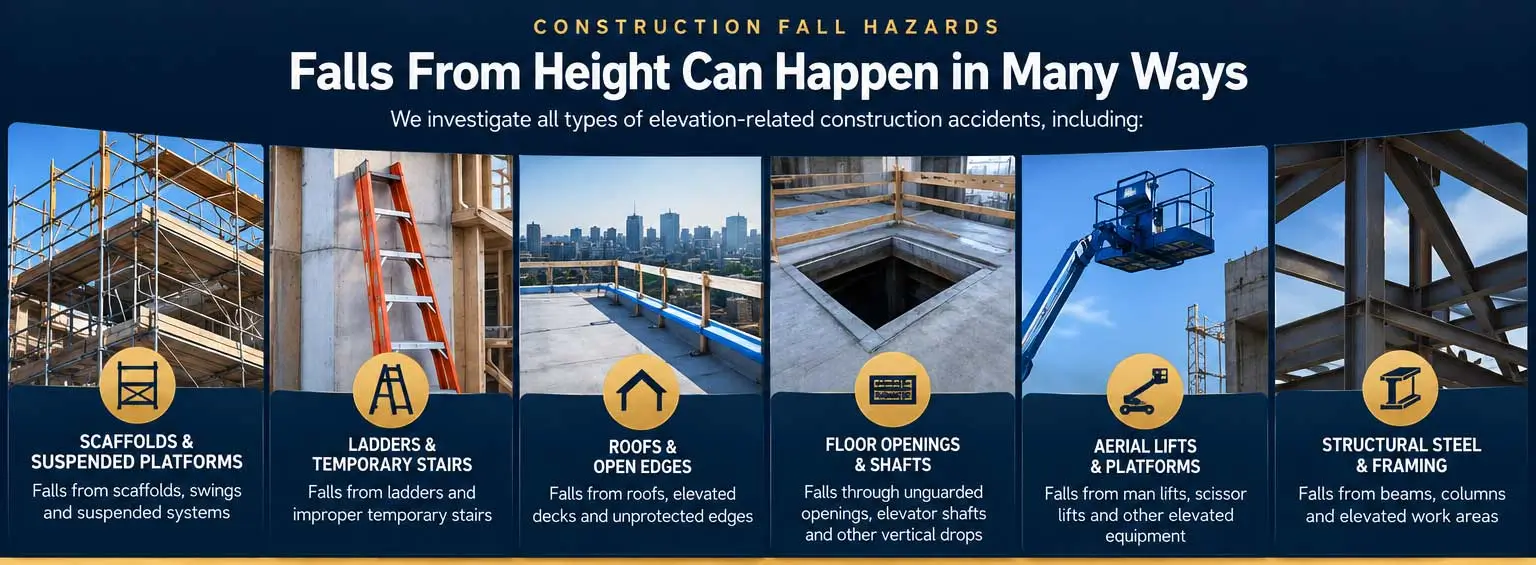
Types of Fall From Height Accidents We Investigate
Scaffold Falls
Falls from supported or suspended scaffolds, planks, temporary platforms, and other scaffold systems.
Ladder Falls
Falls involving unsecured, damaged, defective, improperly positioned, or inadequate ladders.
Roof & Edge Falls
Falls from roofs, elevated decks, structural steel, beams, unprotected edges, and temporary structures.
Floor Openings & Shafts
Falls through unguarded floor openings, elevator shafts, pits, and other openings on construction sites.
Aerial Lifts & Platforms
Falls involving man lifts, aerial platforms, temporary stairs, ramps, and elevated walkways.
Hoisting & Crane Work
Elevation-related accidents involving hoists, lifting operations, or crane work when a worker is exposed to a qualifying fall hazard.
For scaffold-specific claims, see our New York scaffold accident lawyer page.
Common Causes of Construction Falls
Determining why the fall occurred is often central to identifying responsible parties and the laws that may apply.
- Missing or inadequate guardrails
- Failure to provide harnesses, lifelines, or anchor points
- Unsecured or improperly positioned ladders
- Improperly assembled or unstable scaffolding
- Uncovered or unguarded floor openings
- Slippery, cluttered, uneven, or unstable work surfaces
- Defective platforms, lifts, planks, or safety equipment
- Unsafe access routes or temporary stairs
- Inadequate supervision, inspection, or safety planning
Injuries Caused by Falls From Heights
- Traumatic brain injuries
- Spinal cord injuries and paralysis
- Neck and back injuries
- Complex fractures and pelvic injuries
- Internal organ damage
- Crush injuries
- Permanent disability or disfigurement
- Fatal injuries
Severe falls may prevent a worker from returning to construction employment and create long-term needs for surgery, rehabilitation, medical treatment, or daily assistance.
How Labor Law §§240 and 241 May Apply
The legal theory depends on the work, the hazard, the safety devices involved, and the circumstances of the accident. A fall does not automatically establish a statutory claim.
Labor Law §240 — Elevation Hazards
New York Labor Law §240, commonly known as the Scaffold Law, may apply when a covered worker is injured because an appropriate elevation-safety device was absent, inadequate, improperly placed, or failed. It may apply to certain scaffold, ladder, roof, hoist, platform, and falling-object accidents.
When §240’s requirements are met, ordinary comparative negligence generally does not reduce the worker’s recovery, although defendants may raise defenses including sole proximate cause.
Read our New York Labor Law §240 guide →Labor Law §241(6) — Site Safety Rules
Some construction falls involve specific Industrial Code violations concerning passageways, work surfaces, lighting, debris, equipment, or other jobsite conditions. Depending on the facts, a worker may have a claim under §241(6), sometimes alongside another claim.
Read our Labor Law §241(6) guide →Who May Be Responsible?
Depending on the project and how the fall occurred, potentially responsible parties may include:
- Property owners
- General contractors
- Construction managers or statutory agents
- Subcontractors that created or controlled an unsafe condition
- Equipment or scaffold companies
- Manufacturers or suppliers when defective equipment contributed to the fall
An injured worker’s direct employer is generally protected from an ordinary personal-injury lawsuit by workers’ compensation exclusivity, subject to limited exceptions. Separate third-party claims may still be available.
Evidence Can Disappear Quickly
Construction sites change rapidly. Openings may be covered, ladders replaced, scaffolds moved, debris removed, and safety devices added after an accident.
- Scene photographs and video
- Accident and incident reports
- Witness information
- Site-safety plans and inspection records
- Training and toolbox-talk records
- Contracts identifying project participants
- Equipment maintenance records
- Medical and wage records

What Compensation May Be Available?
A successful third-party construction fall claim may allow recovery for losses that workers’ compensation does not fully cover. The available damages depend on the facts and injuries.
Medical & Care Costs
Past and future medical treatment, rehabilitation, long-term care, and related expenses.
Income & Earning Capacity
Lost wages, employment benefits, and reduced ability to earn income in the future.
Human Losses
Pain and suffering, permanent disability, scarring, disfigurement, and loss of enjoyment of life.
What Should You Do?
Seek Medical Care
Prompt treatment protects your health and documents the injury.
Report the Accident
Notify your employer, supervisor, or site representative.
Photograph the Scene
Document the ladder, scaffold, opening, platform, roof edge, safety equipment, and surrounding conditions when possible.
Identify Witnesses
Preserve names and contact information for coworkers and others who saw the accident or unsafe condition.
Preserve Records
Keep medical documents, pay records, union information, photographs, messages, and insurance correspondence.
Be Cautious With Statements
Avoid guessing about facts or signing documents you do not understand.
Speak With a Construction Accident Lawyer
Early investigation may help preserve evidence and identify responsible parties.
Results in Serious Construction Injury Cases
Berkowitz & Weitz Law has recovered substantial compensation for seriously injured clients. Every case is different, and prior results do not guarantee a similar outcome.
Crane Accident Catastrophic Injury Recovery
Recovery for a truck driver who suffered catastrophic pelvic injuries in a crane accident, resulting in permanent disabilities and future lost earnings.
Prior results do not guarantee a similar outcome.
Experienced New York Injury Lawyers
Andrew D. Weitz and Robert J. Berkowitz represent injured New Yorkers in serious construction and personal injury claims. The firm investigates the circumstances of construction falls, identifies potentially responsible parties, preserves evidence, and develops claims involving New York Labor Law when applicable.

Trial-Ready Representation for Serious Construction Falls
Our attorneys investigate how the fall occurred, identify potentially responsible owners and contractors, preserve jobsite evidence, review contracts and safety records, work with qualified experts when necessary, and pursue compensation from appropriate sources.
Construction Law Experience
Experience handling serious construction claims involving Labor Law §§240 and 241.
Detailed Investigation
Analysis of owners, contractors, subcontractors, equipment companies, safety records, and site evidence.
No Fee Unless We Win
Free consultations and no attorney’s fee unless compensation is recovered for you.
Explore Related Construction Accident Claims
Construction Accident Lawyers
Our main New York construction injury practice area.
Scaffold Accident Lawyers
Claims involving scaffold falls, collapses, and unsafe scaffold systems.
Crane Accident Lawyers
Serious crane, rigging, hoisting, and lifting-operation accident claims.
Labor Law §240
Our guide to New York’s Scaffold Law and qualifying elevation-related hazards.
Labor Law §241(6)
How specific Industrial Code violations may support construction injury claims.
Catastrophic Injury Attorneys
Representation after life-changing injuries and permanent disability.
Construction Fall FAQs
Does every construction fall qualify under Labor Law §240?
No. Coverage depends on the work being performed, the elevation-related hazard involved, the parties, the safety devices available, and what caused the fall.
Can I bring a claim after receiving workers’ compensation?
Potentially. Workers’ compensation provides benefits through the employer, while a separate third-party claim may be available against an owner, contractor, or another responsible entity.
What if I was partially at fault?
Partial fault does not necessarily defeat a Labor Law §240 claim. Defendants may still argue that the worker’s conduct was the sole proximate cause. The result depends on the facts.
Who may be responsible for a construction fall?
Potentially responsible parties may include property owners, general contractors, construction managers, subcontractors, equipment companies, and manufacturers, depending on their roles and how the accident occurred.
How long do I have to file a claim?
Many personal injury claims are subject to a three-year limitation period, but shorter deadlines may apply when a government-related entity is involved. Prompt legal review is important.
Speak With a New York Construction Fall Lawyer
If you or a loved one was injured in a ladder fall, scaffold fall, roof fall, platform fall, or another elevation-related construction accident, learn whether you may have options beyond workers’ compensation.